Sunday, February 16, 2020

Evolve or Die

Old vs new technology

The writing's on the wall; what was once state of the art technology will one day become an obsolete antique.  We see it all the time; VCRs get replaced by DVD players, video game consoles get replaced by the next generation, new phones that come out every year or two, MySpace gets replaced by Facebook, etc.  Technology grows and changes as time moves on, and whether we like it or not, we have to change with it, otherwise we'll be left in the dust.  To quote the article "16 Skills Every Marketing Pro Should Master In 2018";

"With all of these new tools comes a demand for a new set of skills to use them" (Forbes Communications Council, 2017)

Ergo, it becomes important to know what the latest trends are and how we can best change with them.  By doing this, we can not only be aware of our audience, but can most likely think of ways to get them more interested in our stories (as, like I mentioned in the last article, the amount of interest in a story does also depend on the person).  I actually recommend checking out the article in question, which you can find here.  It lists multiple strategies that can be employed in communications and journalism that can helps users adapt.  But in the end, it all comes down to one thing.  In order to stay relevant in our modern time, we need to learn how to use the latest technology while being aware of changing social trends.  If we can grasp both of these factors, it can in turn help us to improve our own communications skills and better connect with our audience.

References

Forbes Communication Council. (2017). 16 Skills Every Marketing Pro Should Master In 2018. Forbes. Retrieved from https://www.forbes.com/sites/forbescommunicationscouncil/2017/12/21/16-skills-every-marketing-pro-should-master-in-2018/#6a8730c0345b

Image Sources:

Twin Design. (n.d.). Old vs new technology [Stock picture]. Retrieved from https://www.shutterstock.com/image-photo/old-vs-new-technology-1130860016

Where, When, and How?

In my last post, I discussed the beginnings of technology in relation to journalism and communication.  For this post, I would like to discuss how social media has influenced how news is gathered, and how it affects dissemination.  With the advent of social media, news organizations aren't just relegated to getting information on recent events via on the job interviews.  Instead, they can go to Twitter or other social media platforms and gather information from eye witnesses who tweeted about the event while it was occurring.  Now, in some cases, this isn't a regular practice as eyewitness reports seized through social media can be biased, but the fact that it is a usable resource at all just shows how far we've come in our technology.  Plus, while it may not be used all the time, it has been done.  For example, in the article "Technology and Journalism: 'Dissolving' Social Media Content into Disaster Reporting on Three Chinese Disasters", senior journalist Jinrong Tong looked at five major news sources from China and Britain as they reported on three major disasters and how many times they used social media for reference.  Eventually, they found that "the Chinese newspapers quoted content from social media 131 times, while their British counterparts did so only nine times" (Tong, 2017).  The British papers mostly cited social media for the purpose of "debunking stories on social media as fake or based on rumours or by exposing criminal activities on social media intended to exploit the disaster for personal gain" (Tong, 2017), while the Chinese papers mostly quoted social media for the sake of public interest, such as monitoring government activities and individuals.

Twitter, Tweet, Twitter Bird, Social Network, Internet

Regardless of the reason, the fact that papers were able to use social media as reference shows how far technology has come.  Even today, thanks to technology, people can access news information from anywhere!  Although, a downside to this is that, depending on the person, the amount of news accessed may not change.  In the article "Interactive uses of journalism: crossing between technological potential and young people’s news-using practices" a study was performed with young Finns (nickname for residents of Finland), they found that "even though young Finns have easy access to new communication technology, journalism is still predominantly used via television and printed newspapers" and that "technology alone does not seem to alter news practices" (Hujanen  & Pietikäinen, 2004).  As such, while technology can give us access to new means of news dissemination, it depends on our own interest whether we use it.

Teenager on mobile phone

References

Tong, J. (2017). Technology and Journalism: 'Dissolving' Social Media Content into Disaster Reporting on Three Chinese Disasters. The International Communication Gazette 2017, Vol. 79(4) 400–418. doi: 10.1177/1748048516682142

Hujanen, J., & Pietikäinen, S. (2004). Interactive uses of journalism: crossing between technological potential and young people’s news-using practices. New Media & Society, vol 6(3), 383-401. doi: 10.1177/1461444804042521

Image Sources:

Clker-Free-Vector-Images / 29583 images (2014). Twitter Tweet Twitter Bird Social Network Internet [Image]. Retrieved from https://pixabay.com/vectors/twitter-tweet-twitter-bird-312464/

[Teenager on her phone]. Retrieved from https://www.netdoctor.co.uk/parenting/teenager/a28210/kids-always-on-phone/

Saturday, February 15, 2020

Lights! Camera! ACTION!!!

COME ONE, COME ALL!  Ladies and gentlemen, boys and girls, children of all ages, it is my pristine honor to introduce to you, one of the greatest wonders of the modern world!  Ladies and gentlemen, I present to you, TECHNOLOGY!

Over the years, technology has become a more prominent aspect of our lives, whether we like it or not.  With advances in technology coming as far as they have, the ways we perform our every day tasks has continued to change and advance as well, especially in journalism and communications.  Even before we had our modern amenities, technology has always continued to grow, as well as how we've integrated it into our everyday lives.  For example, let's take the Wayback machine and go back to the early 1900s, specifically, to the world of film.  According to the article "Exhibitors, Technology, and Industrial Journalism in The 1910s and 1920s", Industrial Journalism continued to grow and change with the time.  In fact certain individuals, such as entrepreneur Horace M. Swetland claimed that "The basic purpose of Industrial Journalism is to assist in the production and distribution of commodities" (Swetland, 1923). Essentially, journalism wasn't just there to inform, but "through lectures, books, and organizational activities, Swetland and the nation’s other leading business publishers sought to legitimize their profession and argue for its importance to American industry" (Hoyt, 2015).


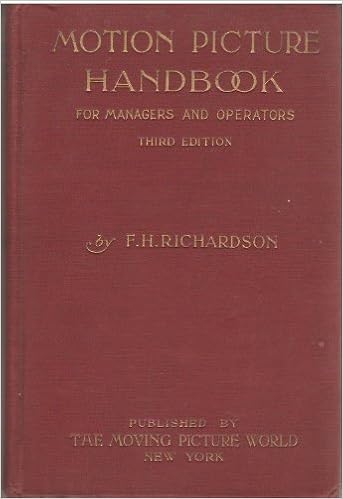
They did this through various means, specifically, as the article mentions, three industrial periodicals called technical, class and trade.  Technical journals were mainly used for "disseminating technical knowledge, legitimizing the organization, and policing the boundaries between insiders and outsiders" (Hoyt, 2015).  In fact, technical journals were used as a means of instructing people on how to use and operate technologies, with an example being the "Motion Picture Handbook for Managers and Operators" (pictured above).  This was actually a collection of articles that the author, F. H. Richardson, had published for Moving Pictures World, and over the years, such articles were eventually brought together in other publications for handy use and reference, including Accessory News, Better Theatres which was published by the Exhibitors Herald, all of which have been digitized for online use.  In fact, according to the article, with the aid of the search engine of the MHDL, Lantern, "a researcher can type in “arc lamp” and almost immediately generate hundreds of matching results. This is the power of a digital search index, which organizes data in a way that
allows them to be quickly queried and retrieved" (Hoyt, 2015).

I will go into more detail about the evolution of technology in future posts, but as you can see, how we disseminated information, and how we retrieved it, have changed over the years.  What we once had to look up in a written article we can now find online.  It may still take time, but thanks to our modern world, this information is always quick to come by.  To further discuss how technology has become more integrated into our lives, I recommend checking out the article Tapping Technology to Advance the Future of Journalism by Sam Dolnick, as I feel this can give us a window into how we ourselves use it.  For my next post, I will discussing how the integration of social media has affected how we retrieve information, both for news gathering, and for the news itself.

References

Hoyt, E. (2015). Exhibitors, Technology, and Industrial Journalism in The 1910s and 1920s. Velvet Light Trap, 76. 49-53.

Image Source [Motion Picture Handbook for Managers and Operators (Third Edition) by F.H. Richardson] Retrieved from https://www.amazon.com/PICTURE-HANDBOOK-Managers-Operators-Theatres/dp/B002N4GEO2